
Where Does Your Tap Water in Almería Really Come From?


You’ve bought your house here in the sunny Levante region, you’ve settled in, and then one day you ask yourself: Can I drink the tap water in Almería?
Well, the short answer is yes - in most cases, it is legally safe.
But the more relevant question is: Is it the highest-quality water for your home, your appliances, your taste, and your long-term health?
To answer that, the first step is to gain a clear understanding of your water supply so you can make an informed decision about whether you need water filtration and a water softener in your Almería home.
So let’s explore where your water comes from and what happens to it before it reaches your tap.
Borehole Water - The Hidden Source Beneath Our Feet

If you’ve noticed that ramblas remain dry for most of the year, it probably comes as no surprise that much of Almería’s water supply comes from boreholes drilled deep into the underground aquifers.
An aquifer is like a huge sponge made of rock that holds water beneath the surface. Because the water in it is minimally exposed to oxygen and sunlight, it generally has low levels of bacteria.
Sounds ideal, doesn’t it?
However, boreholes in our region typically contain high concentrations of dissolved minerals, such as calcium carbonate and magnesium carbonate. These minerals are what cause hard water in Almería and the irritating white residue known as limescale.
For we homeowners, this means:
Limescale build-up in kettles, on taps and in shower heads
Reduced lifespan of boilers, washing machines and dishwashers
Pipework that becomes congested and blocked over time
Dry skin, dull hair and fabrics that are coarse after washing
For these reasons, many houses benefit from hard water treatment with a water softener.
Surface Water - Rivers, Reservoirs and Canals
Drinking water may also come from rivers, canals, or reservoirs, and because these sources are open to the elements, they require significantly more treatment.
Exposure to sunlight encourages bacterial growth in water, and surface water can also be affected by:
Chemicals in agricultural run-off
Industrial discharge
Seasonal variations in quality
This is where municipal treatment comes in, including disinfection and chemical balancing.
Desalinated Sea Water

Desalination plants play an important role in Spain's coastal regions, and this area hosts the Carboneras plant, and Bajo Almanzora, as well as the Campo de Dalías - one of Europe’s largest - which supplies water to the 8,000 odd hectares of greenhouses in El Ejido, Vicar and Roquetas de Mar, as well as local residents.
Seawater goes through an intensive reverse osmosis process - sometimes extending more than 30 stages - to remove salt, minerals and other contaminants before entering the distribution system.
Desalinated water is safe, but it’s heavily processed and often remineralised and disinfected before it reaches your tap.
Many homeowners in Almería choose a domestic reverse osmosis system to refine the water’s taste and further reduce residual traces.
Springs and ‘Fuentes’
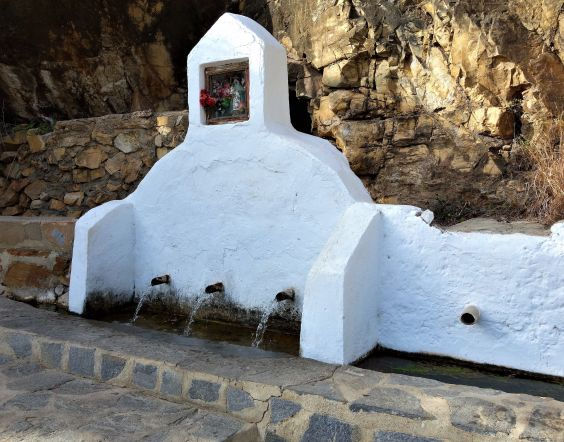
Natural springs - or fuentes - have been in use in the region for centuries, and some residents still prefer to collect their household water in this way.
However, unlike municipal tap water, spring water is not routinely treated. If contamination occurs, there is no ongoing monitoring system to protect the end user.
How is Tap Water Treated in Spain?
Under the Spanish Royal Decree (updated 2023), water suppliers must test and treat drinking water to ensure it is potable (safe to drink). Typical treatment includes:
Chlorine or chlorine derivatives to disinfect
Coagulants and flocculants to remove suspended solids
pH balancing to prevent corrosion
The testing frequency is determined by the size of the population served by the water supply. Smaller areas are often tested quarterly, whereas larger ones may be tested monthly.
During our water testing in homes across the Almería region, we have encountered water that has undergone as few as three treatment stages, up to one supply that had undergone 39 treatment stages. And we’ve seen water supplied from a single source, right up to water that comes from a mixture of four different sources.
But it’s important to understand one thing: the goal of municipal treatment is safety - not taste, not appliance protection, and not removing every residual chemical.
The Myth: “You Can’t Drink Tap Water in Spain”
This is absolutely untrue. Unless you have received official notification, your tap water is legally safe to drink. But that doesn’t mean that:
It tastes good
It won’t damage appliances
It won’t leave limescale everywhere
It’s ideal for long-term consumption
For homeowners who have invested in their property, the real question becomes:
Do you want to improve the quality of the water you use every single day?
The Sensible First Step
Before choosing any system - whether that’s a whole house water filter, reverse osmosis system, or a water softener for limescale in Almería - you need to know exactly what is in your water.
That’s why Almeria Pure Water offers a FREE 24-point water test in your home, with absolutely no further obligation.
It’s detailed
It's conducted by an expert in water
It’s practical
And it gives you clarity and peace of mind
From there, you can make a calm, informed decision about the right home water filtration system for your property if, indeed, you need one at all.
If you’ve spent years building a life here, it makes sense to protect your home and yourself with better quality water.
BOOK YOURS TODAY: Phone / WhatsApp +34 613 41 26 30
Email: contact@almeriapurewater.com


Comments